

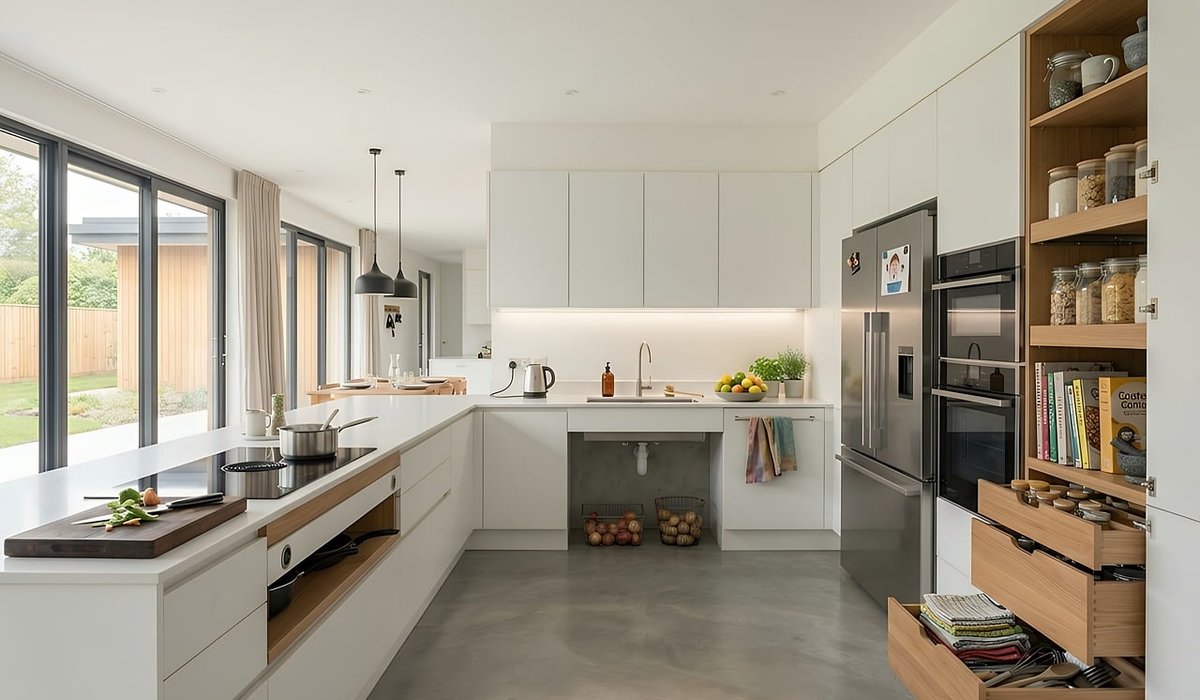
Why north-facing rooms read differently
North light in the UK is cool, indirect and remarkably steady. It rarely throws direct sun across a room, so instead of golden warmth you get a soft, faintly blue-grey wash that barely shifts between morning and evening. In a Victorian terrace box room, a 1930s semi with one north window, or a modern flat facing the wrong way, that means colours which looked inviting in a bright showroom can turn chalky, dim or quietly chilly on your walls.
The good news is that north light is also flattering and even. It doesn't glare, it doesn't fade fabrics at speed, and it never washes out a deep shade. The trick is to choose paint with warm undertones — yellow, red, pink or orange — so the walls are doing a little of the sun's work for you. A north-facing small room painted thoughtfully often feels calmer and more expensive than a south-facing one that's been left plain white.
The three colour families that work hardest
If you want a shortcut, keep your palette within three families. They're broad enough for a whole flat, and each one counters cool light in a different way:
- Warm whites — off-whites with a hint of yellow, pink or cream rather than grey or blue. These keep small rooms feeling open.
- Soft pinks — dusty rose, plaster pink, blush and clay. Pink bounces warmth onto skin and wood without ever shouting.
- Earthy neutrals — oatmeal, mushroom, warm greige, muted olive, soft terracotta and caramel. Grounding, forgiving and very good at hiding the odd scuff in a rented hallway.
Warm whites that stay bright, not chalky
Pure brilliant white is a trap in a north room. Titanium-white paint has no warmth to give, so under cool light it can look grey, particularly on ceilings and in corners. Choose an off-white with visible cream or pink in it, and you'll get the airy feel you were after without the chill.
When you look at a colour card, hold it against a sheet of copier paper. If the paint looks pinkish or buttery beside it, that's your warmth. If it looks faintly blue or green, put it back. For a genuinely small room, paint walls and ceiling in the same warm white, or take the ceiling one shade lighter — a hard white ceiling above warm walls creates a dark band that shrinks the space.
Two practical notes: buy a sample pot, not a tester card, and paint A2-sized patches rather than tiny squares. Small patches make colours look more saturated than they will on a whole wall.
Soft pinks, earthy neutrals and warm accents
Pinks are the quiet heroes of north-facing bedrooms and living rooms. A muted plaster pink or dusty blush on all four walls warms the light and makes white woodwork sing. If that feels bold, use it on the chimney breast or the wall behind the bed and keep the rest a warm white.
Earthy neutrals do a similar job with more weight. Warm greige, oatmeal and mushroom are excellent in hallways and studies, while muted olive, ochre and terracotta bring depth to a snug or dining nook. For a north-facing room you also want to use a bolder shade than you would elsewhere: north light flattens saturation, so the colour you choose will read roughly two shades softer on the wall than on the card.
Deep colours — a warm mustard, a brick red, a dark olive — work beautifully on a single wall as a focal point, especially in small spaces where you want a corner to feel intentional rather than merely dim.
Colours that can fall flat in north light
Some shades simply struggle when there's no sun to lift them. Be cautious with:
- Cool greys and blue-greys — they can turn the whole room the colour of a rainy Tuesday.
- Icy whites and cool-toned beiges — pleasant in a south room, institutional in a north one.
- Strong navy and inky blue — dramatic, but cold in volume; warm them with lamplight and timber if you use them.
- Duck-egg blue on woodwork — it's a British classic, but in north light it reads grey-green. Try a warmer off-white or soft stone instead.
None of these are banned. They just need help — a warm rug, a brass lamp, a wooden floor — to stay welcoming.
Renter-friendly testing, finishes and lighting
If you rent, you can still get this right. Start by painting large sample patches on the wall and living with them for a week, checking them at 8am, midday and 9pm with the lights on. Paint shops will mix a small pot to any colour you like, and removable self-adhesive wall panels or peel-and-stick wallpaper are a genuine option for a feature wall you can take down at the end of a tenancy. Many landlords will also agree to a repaint if you offer to return the room to its original colour, so it's always worth asking before you assume.
Finish matters as much as hue. Matt emulsion absorbs light and softens edges — lovely on walls, but a low-sheen or washable matt (around 10–20% sheen) reflects a little extra light and stands up to small-space life. Use a durable eggshell on woodwork in a warm off-white rather than a stark one.
Finally, lighting. Swap cool white bulbs for warm ones around 2700K, add two or three small lamps rather than relying on one ceiling fitting, and place a mirror opposite the window to bounce that steady north light back into the room. Get those three things right and almost any warm paint colour will hold its own, whatever the weather does outside.


Coding is used in almost all aspects of life and work now, be it directly or indirectly. It’s not just for companies in the tech sector. “An increasing number of businesses rely on computer code,
Coding is used in almost all aspects of life and work now, be it directly or indirectly. It’s not just for companies in the tech sector. “An increasing number of businesses rely on computer code,
Coding is used in almost all aspects of life and work now, be it directly or indirectly. It’s not just for companies in the tech sector. “An increasing number of businesses rely on computer code,