

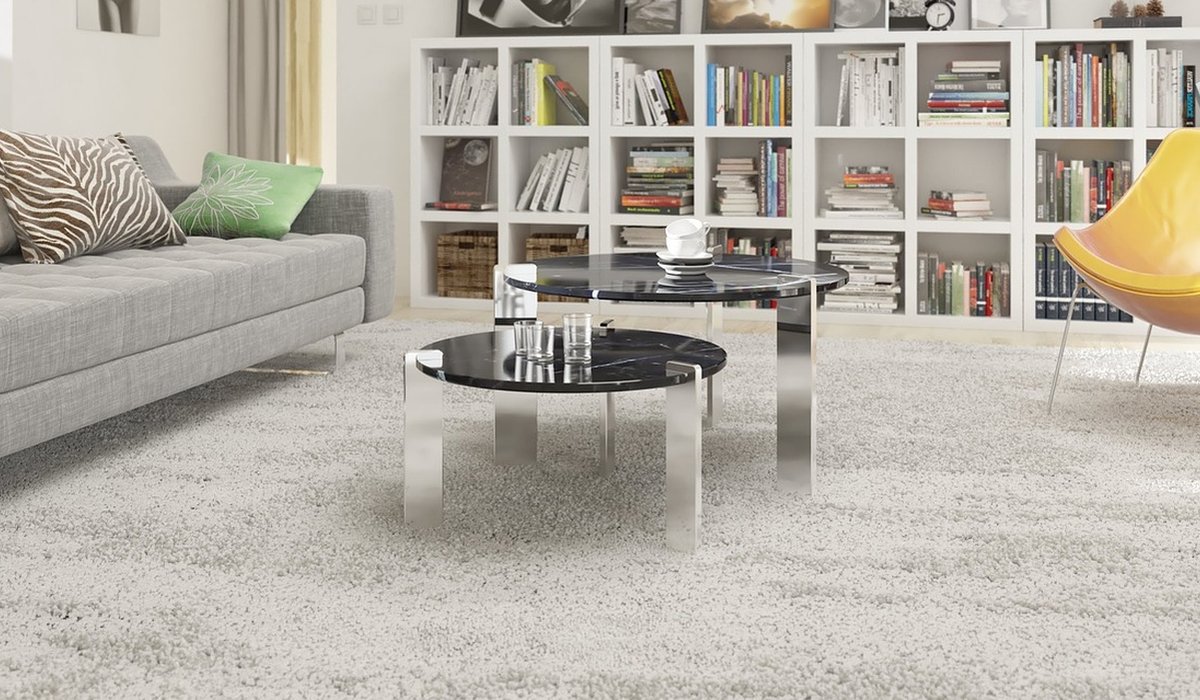
Start with a single, consistent colour palette
Nothing shrinks a small living room faster than a patchwork of contrast. If your walls are pale, your sofa mid-brown, your rug patterned and your curtains a different blue, the eye stops at every boundary — and each stop makes the room feel tighter. Choose one colour family and let most of the room sit inside it: off-white, soft grey, chalky clay or pale sage. Then vary texture rather than hue — a linen sofa, a wool rug, a cotton throw.
Paint ceiling, walls and skirting in related tones; keeping those edges soft blurs the room's boundaries, whereas a bright white ceiling over dark skirting draws a hard line. Matt emulsion is the friendlier finish in older UK housing stock, hiding imperfect plaster. If you rent and cannot repaint, bring in a large rug, curtains and a throw in one matching tone so the eye reads a single calm field.
Use mirrors to borrow light, not just to decorate
A well-placed mirror does the work of knocking through a wall. Hang one opposite a window where it catches daylight, rather than on the window wall where it will only reflect curtains. Aim for at least 60cm wide: small mirrors punctuate a wall, large ones genuinely extend it.
- Lean a full-length mirror behind a corner sofa — secure it with anti-tip straps rather than leaving it freestanding.
- Hang one above a chimney breast or radiator so it reflects the opposite side of the room.
- Consider a mirrored splashback or an antique-finished panel; slight cloudiness looks warmer than flawless glass while still doing the job.
- Avoid facing two mirrors at each other — endless reflection feels unsettling rather than spacious.
Choose low, slim and leggy furniture
Height is the enemy of a small room. Anything tall and solid interrupts the sightline, so look for sofas with low backs — under about 75cm — and slim arms. Legs matter too: a sofa raised on visible legs lets the floor run underneath, and the eye reads that continuous floor as extra room.
- A glass or slim metal coffee table occupies the same footprint as a chunky wooden one but visually disappears.
- Wall-mounted shelving and a floating media unit beat a tall bookcase; if you must go tall, keep it narrow and pale.
- Console tables around 30–35cm deep suit a bay window or the space behind a sofa.
Re-plan the layout around movement, not walls
Most small living rooms are pushed apologetically against the walls, leaving dead space in the middle. Pull the main sofa 10–15cm off the wall, float a chair at an angle, and let the seating sit slightly into the room. You need roughly 45–60cm of clear walkway between pieces — measure it with your feet rather than guessing.
Rugs are a common mistake. A small rug divides the floor into fragments; choose one that runs under at least the front legs of the seating, and ideally all of it. In a tiny room, a rug that nearly reaches the skirting makes the floor read as one continuous plane.
Stretch the room upwards and outwards
Hang curtains as close to the ceiling as possible and let them fall to the floor, with the pole extending 15–20cm beyond the window frame on each side. The result is a taller window, more light and a less interrupted wall. Choose curtains close in tone to the walls so they read as architecture rather than a block of colour.
A low-hung pendant chops the ceiling height; swap it for wall lights, a slim floor lamp or table lamps at different heights, with warm bulbs rather than stark white ones. If there is a chimney breast, use the alcoves for low storage in the same colour as the walls, so the shelves recede instead of shouting.
Renter-friendly tweaks that cost very little
If you cannot drill, you can still do a great deal. Tension rods work in recessed windows for lightweight curtains, and adhesive hooks hold small frames and lightweight mirrors if you respect the weight limit and prepare the surface properly. Over-door hooks and slim behind-the-door storage keep clutter out of the main sightline.
Then edit ruthlessly. In a small room, every surface is a decision: one or two objects on a shelf read as considered, six read as overflow. Keep the floor and window sill as clear as you can, and add one large plant rather than a cluster of small ones. It is the cheapest space-creating trick there is, and it works in rented flats and owned homes alike.


Coding is used in almost all aspects of life and work now, be it directly or indirectly. It’s not just for companies in the tech sector. “An increasing number of businesses rely on computer code,
Coding is used in almost all aspects of life and work now, be it directly or indirectly. It’s not just for companies in the tech sector. “An increasing number of businesses rely on computer code,
Coding is used in almost all aspects of life and work now, be it directly or indirectly. It’s not just for companies in the tech sector. “An increasing number of businesses rely on computer code,